
Plyometrics and Athlete Development – Part II
The Scoop on Lower-Body Plyometrics
Depending on the movement and force application, certain angles are more favorable for optimal explosive power. Therefore, exercises must be carefully selected to achieve the desired effect.
Dynamic Moving
*Note:Relax by shaking the legs/feet or arms/hands loosely after completing any jumping or body support exercises. Skips, Jumps; Tuck-jump; Lunge-jump; Jump Rope; forward-backward Stride Jump; Gallop; Hops; Bounding (athletics).
Hop Series
Set the distance for all exercises.
Set the repetitions, or a set time (seconds) for all exercises.
Stand upright/Hop series forward (caution)/DA rhythmic swing loosely at the sides of the body/nonstop/6-8repetitions/relax 5-7 seconds or counts, shaking the legs loosely/repeat, opposite foot
Same Exercise: Hop series/DA rhythmic swing loosely at the sides of the body/moving quickly in back and forth rhythm/nonstop/6-8 repetitions/relax 5-7 seconds or counts, shaking the legs loosely/repeat, opposite foot
Hop Series with Half-Turn
Stand upright/Hop series/DA rhythmic swing, loosely at the sides of the body/set distance/adding an L-side half-turn/face in the opposite direction/ adding an immediate Hop with Half-turn (180°) to the L-side/facing forward (counter-clockwise pattern 360°)/continue/4-6 repetitions/relax 5-7 seconds or counts, shaking the legs loosely/repeat, Hop with Half-turn to the R-side
*Note: After the first 180° Half-turn, the body faces in the opposite direction, and the second 180° Half-turn is followed immediately to face forward again in the previous direction of travel. The two half-turn movements challenge agility (changing direction without losing speed, balance, and rhythm).
Hop Series with Directional Change
Set the distance.
Determine the starting point and distance for each direction.
Stand upright, feet slightly apart/arms at the sides of the body/facing forward /hop (1 foot) forward, set distance/hop backward to the starting point/hop sideways to the R-side/return to the starting point/hop sideways to the L-side /return to the starting point/6-8 repetitions/relax 5-7 seconds or counts, shaking the legs loosely
Slalom Jumps and Hop Series
Set the distance.
Stand upright, feet slightly apart/arms at the sides of the body/facing forward/2-foot jump, side-to-side, nonstop/2-3 sets of 10 repetitions/relax 5-7 seconds or counts, shaking the legs loosely/repeat, 1-foot hops/repeat, alternating jump and hop series
Dynamic Stationary
Tuck Jump Series
Keep the body upright and aligned.
Stand upright/arms loosely at the sides of the body/series of 6-8 consecutive Tuck jumps/DA swing/try for the best height-hip height/land softly, bending the knees to absorb the shock/nonstop/2-sets of 6-8 repetitions, or repeat as needed/relax 5-7 seconds or counts, shaking the legs loosely
Lunge Series
Keep the body upright and aligned.
Stand upright/arms loosely at the sides of the body/quickly jump into a Lunge-stride position, R-leg forward/return to stand/nonstop/2-sets of 6-8 repetitions, or repeat as needed/relax 5-7 seconds, shaking the legs loosely/ repeat, L-leg forward
Ankle Jumps
Stand upright, hands on the hips/facing forward/jump up straight without bending the knees/flexing the ankles, pulling up the toes upward during the jump (dorsiflex)/extending the ankles just before touching the floor/pushing the balls of the feet into the floor explosively/jumping again/trying to keep the feet on the floor for as little time as possible/2 sets, 6-8 repetitions/relax 5-7 seconds or counts, shaking the legs loosely/repeat, increase repetitions/ repeat, increase the number of sets
Double Leg Vertical Jumps
Stand upright, feet slightly apart/arms at the sides of the body/facing forward /jump straight upward, raising arms above the head/2 sets of 10 repetitions/ relax 5-7 seconds or counts, shaking the legs loosely
Combination: Stationary to Moving
Long Jump: Flight and Distance
Small gym mat (5x10)
Stand upright/arms at the sides of the body/DA rhythmic swing/distance jump/land, bending the knees/return to the starting line/4-6 repetitions, or repeat as needed/relax 5-7 seconds or counts, shaking the legs loosely
Vertical Jump: Height
Small gym mat (5x10)
Mark different heights on the wall with tape.
Stand upright parallel next to the wall/arms at the sides of the body/DA rhythmic swings/take 2-3 quick steps/immediate 2-foot jump for height/ touching the best-marked height on the wall/land, absorbing the shock/set number of repetitions, or repeat as needed/relax, shaking the legs loosely/ repeat, changing to the opposite side/2-foot jump
Same Exercise: Single R-foot jump/repeat, L-foot
Wall Rebounding
Combination of Lower and Upper-body Plyometrics.
Stand upright in front of the wall/arms-length away/consecutive jump action forward into the wall/rebound the hands off the wall, feet extended in the air/ nonstop/return to standing/10-15 repetitions, or repeat as needed/relax 5-7 seconds or counts, shaking the legs, hands, and wrists loosely
Push-up with Spring and Handclap in Air
Combination of Lower and Upper-body Plyometrics.
Assume the prone position on the floor (on the front)/legs extended/arms bent, close by the body/rise to push-up position on toes/push with the feet and hands against the floor/spring in the air, clapping the hands/land on all 4s/legs extended on toes/arms bent/nonstop/repeat as needed/relax 5-7 seconds or counts, shaking the legs, hands, and wrists loosely
Plyometric Guidelines
One of the most misunderstood—and often misused—tools in athletic development is plyometrics. Jumping on boxes that are way too high, doing endless “explosive” circuits, chasing highlight clips instead of real development. When used correctly, plyometrics are one of the most powerful tools we have to build speed, power, and resilience such as
Power-Based Plyometrics (Intensive): Long Jump jumps, Vertical jumps, Med ball throws. The goals: producing as much force as possible with low reps, full recovery, and high intent.
Reactive/Extensive Plyometrics (Reactive Strength Index-RSI), speed, and elasticity. Line hops, Pogos, and quick bounding. Coaches must be familiar with plyometric guidelines before designing an age-appropriate training program and the corresponding drills or exercises (Refer to Chart).
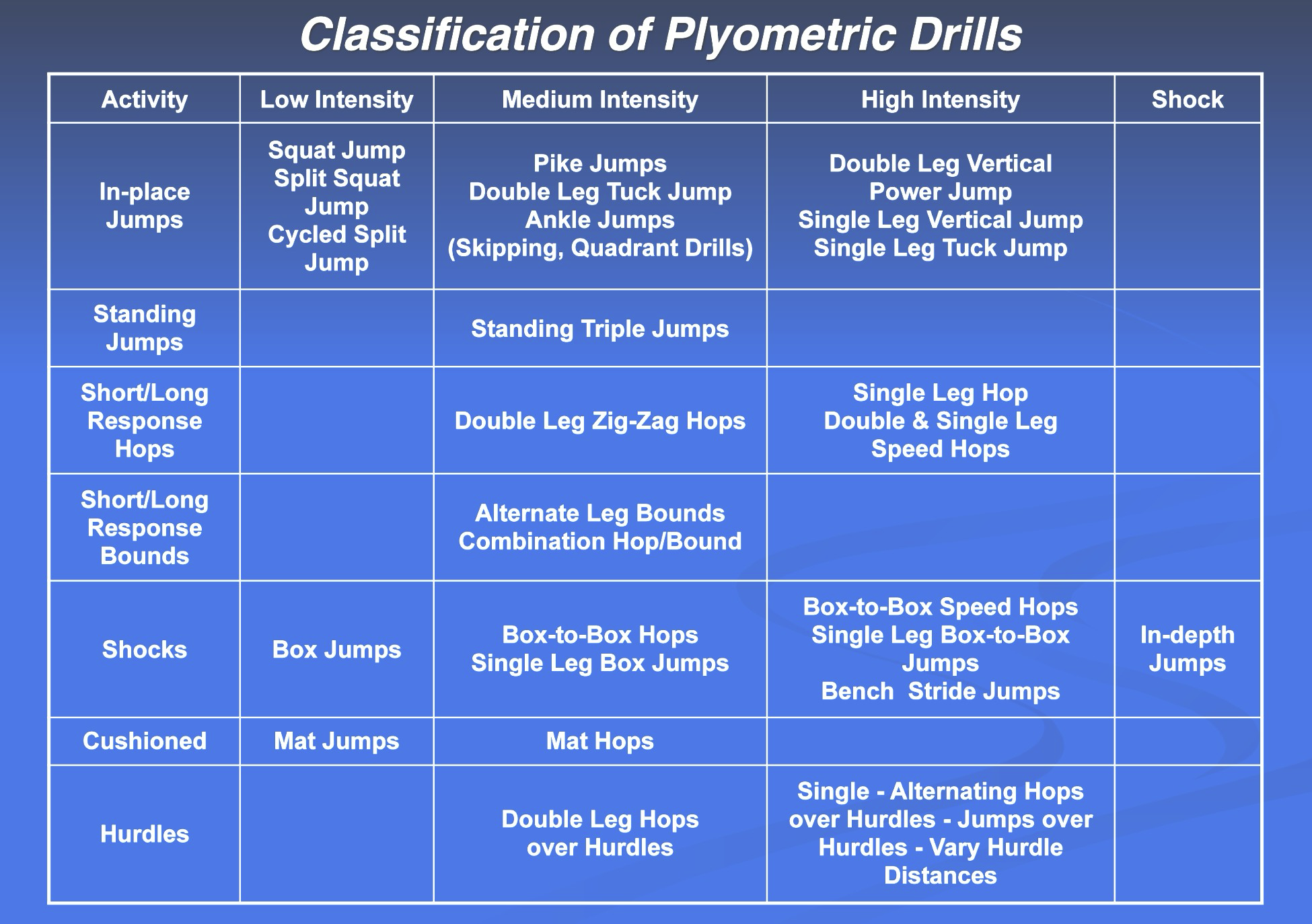
The simplest types for younger athletes are small box jumping and jump rope. Coaches must teach proper balance, control, and landing techniques for jumping activities. Ultimately, they must duplicate the same movement patterns needed for general, sport-specific, and specific skills or activities trained in the session ahead. They should begin plyometric exercises with simple fundamental skills and progress gradually so athletes can develop coordination and training tolerance for this type of activity. They also need to consistently assess and monitor how athletes perform each exercise, which may be more challenging for those who require a stronger foundation and are slightly overweight. Be aware that excessive stress on the lower back, hips, knees, and ankles can lead to injuries. When progressing to higher-intensity plyometric skills that fatigue the neurological and muscular systems, it is essential to allow sufficient recovery before performing these skills again. Due to the intense demands on the body, longer recovery periods between sets may be necessary, but these should be carefully monitored. More research on the optimum recovery time is needed, though suggestions for the interval between training sessions generally ranges from 48 to 72 hours for higher-intensity workouts and 24 to 48 hours for lower-intensity exercises. The typical recommended inter-set recovery time for plyometric training is between 2 minutes and 4 minutes. Traditionally, the more explosive the movement, the shorter the work period should be, followed by a longer rest period. The work phase can be as brief as three repetitions or 10 seconds, while rest can be as short as 20 seconds or as long as two minutes. Rest is crucial for maintaining proper biomechanics and mental focus.
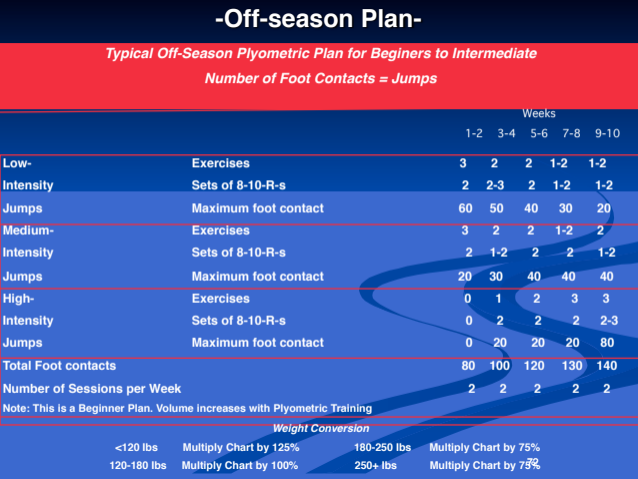
Since most adolescent athletes may need access to equipment such as benches or boxes, simple Jump Rope activities with variation might be the best approach. It must be mentioned that all athletes need to take a break/rest period after the season is finished. That means ‘full rest’ with no activit,y but should begin activities 2-3 weeks before the start of the new season. Younger athletes in the developmental programs are less affected because they train with reduced volume and intensity and most likely keep themselves busy during the off-season. Older age group athletes should maintain some plyometric activity throughout the year to maintain strength, flexibility, and power (Refer to the Chart for selected activities). However, instruction and supervision are essential to prevent injuries in the lower or upper body segments.
Off-season Training For Older Age Group Athletes
Recommended Resources: Schloder, M.E. (2026, to be released). E P-P T. Effective Pre-post training for age-group swimmers. Interactive PDF. PPTx Slide show. Calgary, Alberta, Canada: www.coachingbest.com Schloder, M.E. (2016). Ballet for swimmers: Modified exercises for cross-training. Dual DVDs. Interactive PDF. Calgary, Alberta, Canada: www.coachingbest.com Schloder, M.E. (2018). The Kalos exercise collection: PDF [45 pages]. Calgary, Alberta, Canada: www.coachingbest.com