
Creating and Maintaining A Positive Training, Competition, and Game Environment
Well…. I am on ‘my podium’ to vent frustrations via this article, using two examples in this discussion: Professional Hockey and Competitive Swimming.
About Hockey:
When watching NHL hockey games, I am not your typical ‘hyped-up’ fan; rather, I tend to observe the action and behavior (on the bench, coaches’ interactions, communication, and feedback), players’ movement up and down the ice, and goalies’ motion in the cage and across the crease.
The observations yield valuable insights. I enjoy guessing the outcome and have concluded that “I am actually very good at predicting the results just by watching the first 5-10 minutes… usually ‘right on’ or ‘by one goal off!’” So, what gives?
Observing how players skate, how each line executes its assigned roles, line rhythm and unison, body posture, tempo, strides, reaction time, agility, and mobility tells me a lot about players’ mental attitude, as reflected in their movements and movement patterns. Players frequently ‘run around like chickens with their heads cut off’, using erratic patterns and wasting energy. Not being productive and successful over the past several games shows up as ‘forced’ movement rather than the flow of the game, and an unnecessarily aggressive style that leads to stupid penalties, opposition goals, or, in other sports, disqualifications.
Emotional control should be part of daily training practices. In addition, focus and concentration are affected when the opposition scores one or two goals in the first 2 minutes, the last 3 seconds of a period, or the first 30 seconds of overtime! All these have occurred so far in the 2026 season.
Tracking small wins and achievements in training is crucial for recognizing and reinforcing positive behavior in athletes, including professional athletes. It not only boosts individual morale and confidence but also fosters team spirit, collaboration, and a positive team culture. It encourages continuous improvement – even at the professional level – and sets the stage for long-term success.
First, coaches need to assess whether their daily training program aligns with the goal or outcome for successful performance in the upcoming game or competition. I always follow the ‘golden rule,’ “train the way you want to perform so the bodily system gets used to the physical stress and physiological demand, and learns to adapt.” I question, however, whether the daily training time in hockey really matches the actual demands in ‘live’ games.
Professional hockey players who tell the media, “for sure, we’ve got to do better. We have to try harder… we just were off… etc.”… focus on the next game, etc., etc., excuses, excuses! I have heard it over and over again! So, why hasn't it been fixed? X-number of the same errors result in failure. Well, it is always a learning experience… but repeatedly making the same technical errors is either stupidity, a lack of care, or a lack of personal involvement or commitment. I happen to believe that it is not stupidity, but something is not clicking in that so-called ‘team culture’, despite all the players’ and the media’s disclaimers, while the Head coach takes his gum and throws it onto the team bench or the ice after one game loss (I did not quite catch the full action where it landed)… or stands behind the bench with a ‘sour-pussed’ facial expression, arms folded over the chest or hands in the pants pockets (except when taking notes), denoting a ‘passive and defensive posture! A gentle tap on the shoulder would be an appropriate acknowledgment for any young or older professional athlete.
Hockey, in my opinion, is way behind in addressing mental issues and the ‘yo-yo’ performances of players, and it is often lackluster, as evidenced by high-standing teams suddenly losing several games in a row or to teams with poor standings. The number of mental ‘time-outs’ or ‘leaves for personal reasons’ has increased over the past few years. I attribute this to the fact that many coaches seem to be recycling themselves, and the ‘old guard’, with some exceptions, are former players from earlier times and not educated in anything beyond hockey.
I can attest to that because of my 46 years in the Canadian Coaching Certification Program (NCCP), as a Lecturer, Course Conductor, Facilitator, and Coach Developer for Canada (titles have changed over time). I had one hockey coach (!) across all these courses over the years. When I presented “Introduction to Coaching Theory” on the first evening in the early 1990s, the same coach argued that ethical issues never exist in hockey. My answer was: Never say never! That was the Friday evening session… on Sunday, the news broke about Coach James and his abuse of young Junior hockey players, with subsequent traumatic effects on well-known players later on… Well, well, well, someone had to eat his crow!
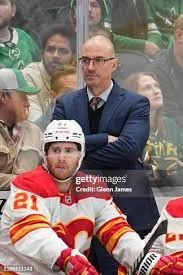
Passive-defensive body language! Facial expression tense, not positive!
Swimming:
I have never been a fan of X-miles or yardage in swimming… “yardage-garbage,” as I call it – because, as a former elite swimmer and track athlete, I did not train at marathon mileage! It always was and still is… Starts, ‘full 100% effort,’ Turns in every swim set, and Finishes, Rhythm, Technique, Technique, Technique… in swim strokes, and the Hurdle, Long- and High jump events.
It does not demonstrate positive behavior modeling: standing passively, or sitting in a chair at swim meets; drinking your coffee; swinging the swim stopwatch in a reverse R-to-L motion; or the frequent coaching behavior in training: standing at the starting-block end with one foot up on the block, sipping your Starbucks. Coaches should “walk as much as the swimmers swim,” correct errors in the wall approach, stroke technique, and wall finishes. Instead, most swimmers ‘dillydally’ into the wall and drift into the finish… “There are no such things as ‘slow Turns and slow Finishes!’ So practice what you need in competition! Start training needs to be integrated more frequently, and not just before upcoming meets, as Starts make up 25% of the overall swim time in the event, as per research. The slow movement just builds ‘bad habits,’ and improvement does not occur through osmosis. Coaches should take notes during competition events for corrections in training sessions, rather than being preoccupied with the stopwatch. Let others take the time splits or wait until the results are posted.
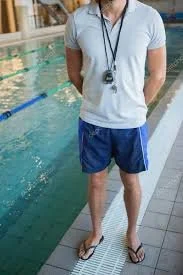
Typical Stance on Pool Deck! Can’t do it without their watch and whistle.
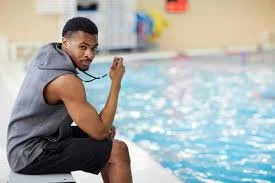
Active Coaching? Sitting down with that stopwatch while swimmers just “do their thing?”
References:
This is a personal opinion and ideology, based on my experience as a head coach in several sports over a long-time and extensive career, my involvement with the Canadian NCCP, my time as a Varsity coach at ASU and Calgary, and my University of Calgary lecture series.
I have taught and coached from beginner to elite and Olympic levels in several sports in the USA and Canada, which has given me a wealth of experience and insight into the sports.
To date, I have trained 28,000 coaches worldwide through courses, seminars, and training camps in Canada, the USA, Finland, Norway, Sweden, Peru, and Ecuador, and have presented at ASCA Swimming World Clinics and the Los Congresos Panamericanos de Educación Física multiple times. I served as the Master Coach in Residence for the former LA-based Amateur Athletic Foundation, Legacy of the 1984 Games (known as LA84 Foundation since 2007), under the direction of USA IOC member, Anita DeFranz, developing the LA Innercity Minority Coach Program, designing Theory and Practicum Courses in Swimming and Soccer, and writing the Coaching Manuals. While the Swim coaches created the AAF Summer Swim League, which grew to include 4,000 inner-city children and youth, the Soccer coaches were prepared for the USA Soccer Grassroots Entry-Level and the D License Certification to coach in their respective communities.

Coaching Association of Canada
Association canadienne des entraîneurs
2021 Community NCCP Coach Developer Award