
Tip of the Month - January 2026
Tips For The Ideal Stretching Routine
We often think of exercise in terms of cardio and strength, but stretching is a crucial—and often overlooked—component of a complete fitness routine. While it may not get the heart racing or leave the muscles burning, consistent stretching can make a noticeable difference in how your body feels and moves each day. Whether you’re an avid exerciser or simply looking to move more comfortably in daily life, making time to stretch can be transformative.
Stretching is an underrated but important part of daily physical activity. Along with improved flexibility, stretching can lead to many health benefits, including:
Increased range of motion in joints
Enhanced circulation
Reduced muscle stiffness and tension
Improved physical performance
Injury prevention
Improved posture
Stress relief
Reference: Harvard Health Publishing (2025, January 9). The ideal stretching routine.
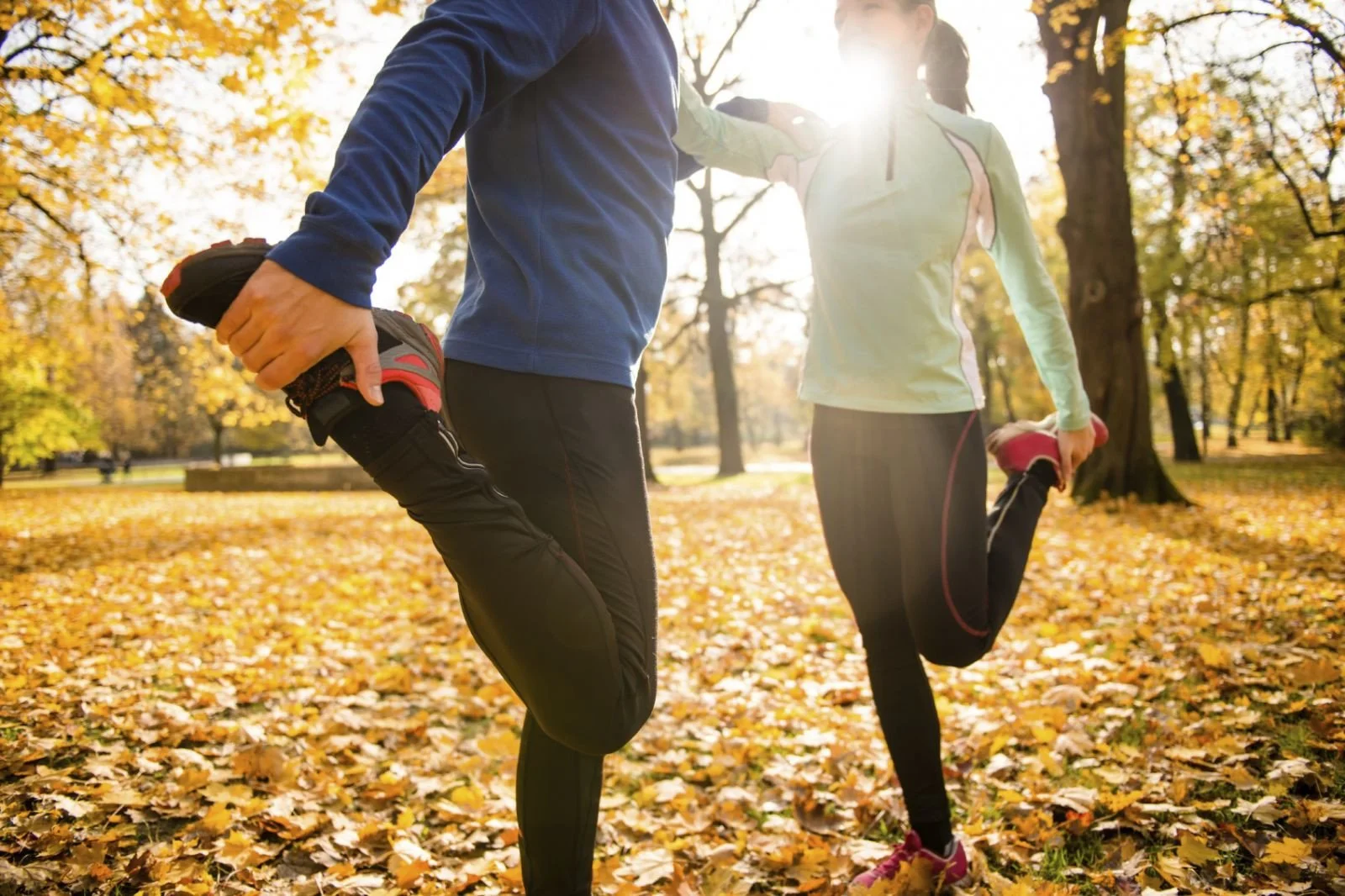
Harvard Health Publishing
According to Harvard Health Publishing, regular stretching is crucial for healthy aging, improving mobility, reducing pain, and potentially enhancing heart health by decreasing arterial stiffness. They recommend stretching all major muscle groups at least twice per week, holding each stretch for 60 seconds after a warm-up, and using gentle static techniques in key areas such as the neck, hips, and legs.
The benefits of “stretching”, whether part of a healthy lifestyle, a specific training program, or an athlete's routine, have long been debated by performance experts. Understanding the basics of stretching, such as how often to stretch, how long to hold each stretch, and the number of repetitions needed, helps maximize the routine and achieve full benefits, including increased flexibility, improved mobility, and injury prevention.
A panel of experts convened by the American College of Sports Medicine (ACSM) reviewed studies to address these questions. Based on the evidence, the panel agreed that:
First and foremost, stretching is an essential part of a healthy lifestyle.
Healthy adults should perform flexibility exercises (stretches, yoga, or tai chi) for all major muscle-tendon groups - neck, shoulders, chest, trunk, lower back, hips, legs, and ankles - at least two to three times a week.
For optimal results, spend 60 seconds on each stretching exercise. If holding a particular stretch for 15 seconds, repeating it three more times would be ideal. If holding the stretch for 20 seconds, two more repetitions would be sufficient.
Incorporating regular stretching into a daily or weekly routine doesn’t take much time, but the rewards can be significant. Whether stretching in the early morning, after a workout/training, or as a relaxing way to unwind in the evening, stretching supports the body’s flexibility, comfort, and resilience. Make stretching a habit, and one will likely notice improvements in movement, feel better, and find handling the demands of everyday life easier.
A regular stretching routine is a simple yet powerful addition to daily self-care.
What does this mean for Athletes in Recreational or Competitive Sports?
In my opinion, an effective program includes an individually prescribed exercise routine to be performed daily at home and during the Pre and Post-training phases of the regular training period. It is critical, however, that the athlete(s) has/have previously completed a total-body warm-up to elevate blood pressure and avoid injury. This is accomplished through various aerobic, dynamic-moving, and dynamic-stationary exercises. I prefer to incorporate flexibility into both phases and combine it with other physical components, such as agility, balance, and strength.
Many of the flexibility exercises in our program are adapted from Classical and Modern Ballet and modified for cross-training in both the Pre- and Post-training phases. In a 2008 comparative study involving dancers from the Royal Ballet of London and British Olympic swimmers, the dancers scored higher on 7 of 10 fitness test items. In fact, dancers are likely the fittest athletes in the sporting scene, and they have to perform their skills with a smile and grace.
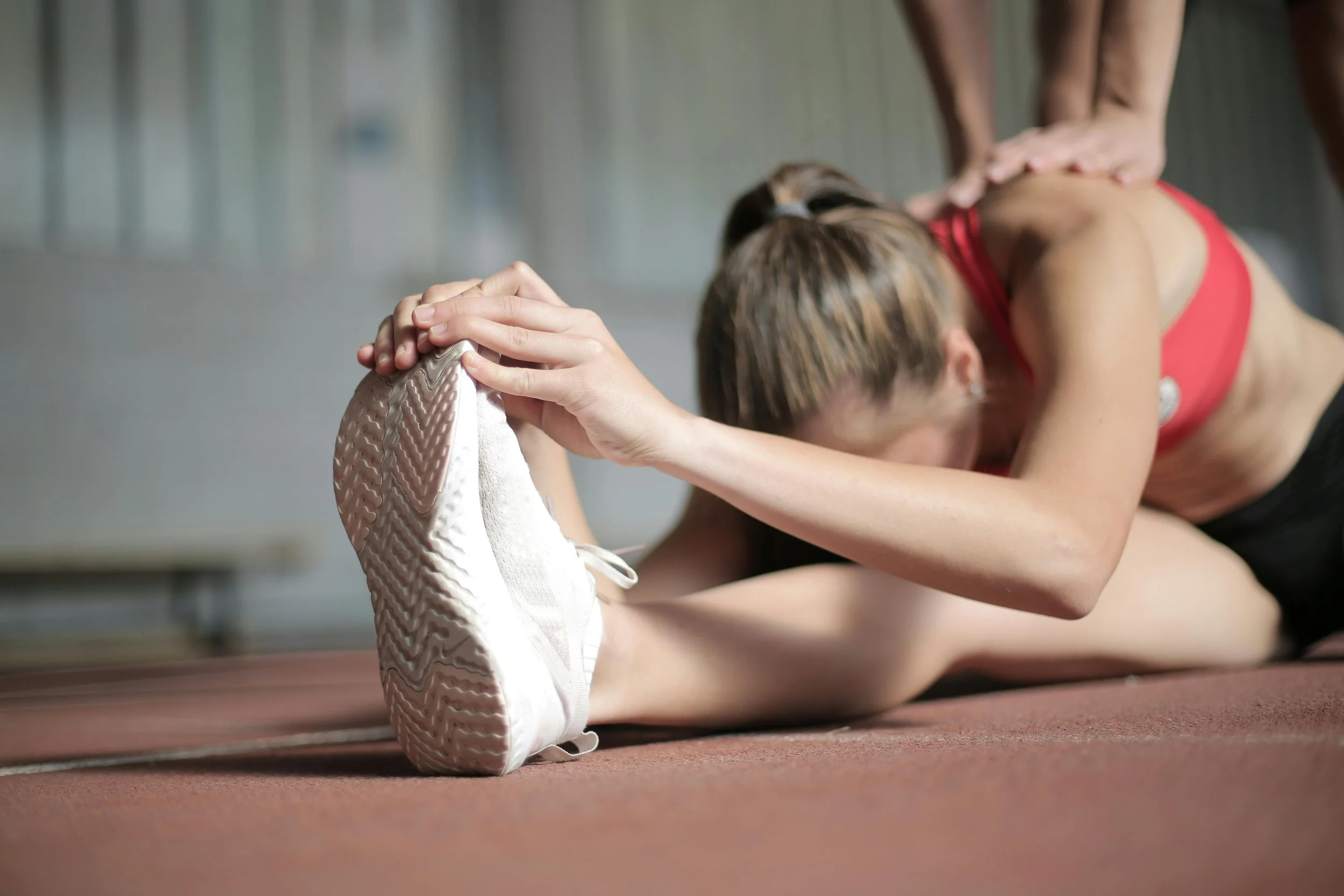
ALERT: The picture illustrates a common error by coaches, trainers, or teammates when assisting with this stretch. The push must be applied around the hip area in the back to achieve the perfect pike position, not by pushing on the shoulders, since the ‘pike’ occurs from bending the hips! The athlete already has a good position. No need to push further, and avoid injury! She should be able to hold this position for 7/10/15/30/60 seconds or whatever the exercise routine requires.
Stretches for the Whole Body to Improve Flexibility and Reduce Pain
Stretching is excellent not only for the general and specific sports skills but also for your health. Simple yet effective moves can help you limber up for sports, improve your balance and prevent falls, increase your flexibility, mobility, and suppleness, and even help relieve back and knee pain. Harvard Health Report recommends 35 stretches, including:
Design and organize the exercise routine:
Begin aerobic activity to warm up the muscles and increase heart rate: dynamic movement and dynamic stationary exercises.
Select exercises that involve the entire body.
Customize the exercises and combine them into a ‘fluid’ routine with a top-to-bottom progression (head to foot) to make it easier or more challenging.
From standing to kneeling to sitting to supine position on the floor.
Include exercises that involve rotation across various positions.
Include ‘free body exercise’ and exercises using elastic bands/straps.
Avoid moving up and down as sitting lowers the heart rate (HR).
Select the best stretches to improve posture and ease neck, shoulder, and lower back pain.
Select 10 moves to Improve flexibility/mobility and ease tight muscles.
Select 8 exercises to loosen up stiff or sore knees.
Select 8 stretches that target key leg and upper body muscles vital for walking, running, and reaching, respective and essential sports skills.
Select 8 exercises for calf, ankle, and foot flexibility

References:
Ballet Alert (2003, August 13). The marriage of football and ballet (cited in Funny Face). Retrieved August 25, 2014, from http://balletalert.invisionzone.com/ index.php?/topic/12948-the-marriageof-football-and-ballet/
Cosell, H. (1980, November 17). “Maybe the most perfect wide receiver of his time. “Comments on Monday Night Football.”
Emmerman. L. (1986, September 29). Dancing around the ‘dumb jock’ image. Retrieved June 15, 2013, from http://articles.chicagotribune.com/1986-09-29/features/8603120713_1_willie-gault-chicago-city-ballet-ballerina
Emmerman, L. (1986, September 30). Willie Gault mixes football and ballet as easily as 1-2-3. St. Petersburg Evening Independent, p. 6-C, posted by Chicago Tribune. Retrieved August 15, from https://news. google.com/newspapers? nid=950&-dat=19860930&id=G2lQAAAAIBAJ&sjid=xVkDAAAAIBAJ&pg= 6709,3762909&hl=en
Garrett, T., & Watson, A. (2008, October 28). Ballet dancers are fitter than international swimmers. Science Daily. Study at the University of Hertfordshire, UK. Retrieved May 2014, from h t t p://www. s c i e n c e d a i l y.com/releases/2008/10/081022073916.htm
Gowdy, C. (1976, January 16). “I always thought that what Swann did was a higher form of art than what Baryshnikov is doing.” Comments during Super Bowl X.
Harvard Health Publishing (2025, January 9). The ideal stretching routine.
Johnson, G. (2014). Swann enjoys the Baryshnikov moniker. The Calgary Herald, pp. D1, D3.
Lord, C. (2011). Ballet keeps Titley’s company on its toes. SwimNews.com. Retrieved May 25, 2014, from http://www.swimnews. com/news/view/8694
Newman, B. (1986, November 24). Gault is divided into many parts. Ballet dancer, model, entrepreneur, and track star. Willie Gault also catches passes for the Chicago Bears – when the quarterback throws to him, that is. Sports Illustrated. SI Vault, pp. 87-97.
People Magazine (1986, October 13). Wide receiver Willie Gault becomes the first dancing bear to perform with the Chicago ballet. People Magazine, 26(15).
Schloder, M.E. (2014).Ballet for athletes. Modified exercises for cross-training. Calgary, Alberta, Canada: Arete Sports/www.coachingbest.com
Schloder, M.E. (2014).Ballet for swimmers. Modified exercises for cross-training. Calgary, Alberta, Canada: Arete Sports/www.coachingbest.com